
Websites & Search
SEO, AEO and GEO in 2026: What Actually Matters for a Website
A practical breakdown of SEO, AEO and GEO, what Google officially recommends, and what I’m implementing on my own website for search and AI discovery.
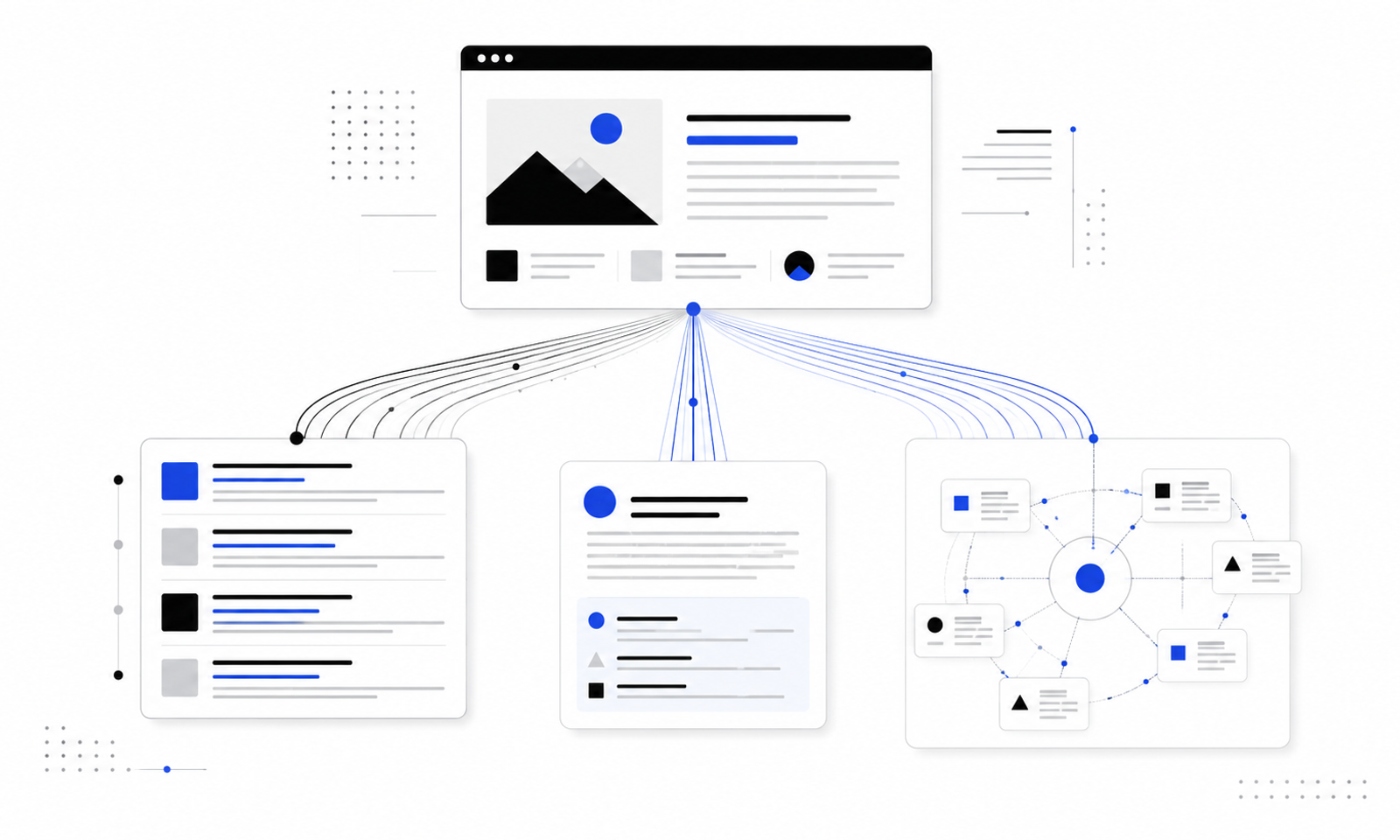
SEO, AEO and GEO in 2026: What Actually Matters for a Website
The language around search has become more complicated.
We now talk about SEO, AEO, GEO, AI Overviews, answer engines, citations and large language models. Each new term arrives with a new checklist. It is easy to feel that a website needs a separate strategy for every interface where somebody might discover it.
I do not think that is the most useful way to approach it.
The interface is changing, but the central job of a website is still familiar: publish something valuable, make its meaning clear, and ensure that machines and people can access it. The difference is that a useful page may now appear as a blue link, supply a direct answer, or become one of several sources behind a generated response.
That changes how I structure content. It does not make the fundamentals irrelevant.
SEO, AEO and GEO in plain language
Search engine optimization, or SEO, is the work of helping search engines crawl, understand and present a website while making its pages genuinely useful to the people who find them.
Answer engine optimization, or AEO, usually describes making information easy to extract as a direct answer. Clear definitions, concise explanations, descriptive headings and well-structured steps all help.
Generative engine optimization, or GEO, usually describes improving the chance that content is understood, selected or cited by generative search systems.
These are useful labels for thinking about different outcomes. They are not three independent foundations.
Google’s current guidance explicitly treats AEO and GEO as third-party terms and says that the same SEO fundamentals remain relevant to its generative AI experiences. Google also says there are no additional technical requirements, special schema types or AI-only files required to appear in those experiences.
That is an important correction to the noise. The goal is not to find a secret AI-search switch. The goal is to make a strong source.
What actually matters
1. A page must be accessible before it can be impressive
Search systems cannot use content they cannot reliably reach.
For a public article, I want the title, summary and body to exist in the HTML delivered to a visitor—not depend entirely on a browser executing a chain of client-side requests. I also want a stable URL, a sensible canonical, working internal links and a sitemap that includes the page.
My website is hosted with GitHub Pages, so the public site is static. When an article is published in Sanity, the website must be rebuilt and deployed again. That constraint is less convenient than instant server-side updates, but the result is straightforward: each published article becomes a complete static page that browsers and crawlers can read.
The practical rule is simple: if the article cannot be loaded, linked and rendered reliably, no optimization layer can rescue it.
2. Clear structure helps humans and machines at the same time
Good structure is not about stuffing a page with headings. It is about reducing the effort needed to understand the page.
For most articles, that means:
- one title that states the subject clearly;
- an introduction that establishes the problem and point of view;
- descriptive section headings;
- direct definitions where a term first appears;
- lists for actual lists, and steps for real processes;
- examples that make abstract claims concrete; and
- a conclusion that answers the question the article opened.
A reader should be able to scan the headings and understand the argument. A search system should not have to infer whether a paragraph is a definition, a warning or a sequence of steps.
3. First-hand evidence is more valuable than reworded information
Generative tools make it cheap to produce another summary of information that already exists. That makes original evidence more important, not less.
Useful evidence can be small. It might be:
- the architecture I chose and why;
- a screenshot of a real result;
- a dated observation from a project;
- the command that failed and the fix that worked;
- a trade-off I had to accept;
- a before-and-after comparison; or
- an honest boundary around what I have not tested yet.
On this website, I want authority to come from shipped work, specific tools, dates, constraints and lessons. I would rather publish a narrow article grounded in a real build than a broad “ultimate guide” assembled from other summaries.
That is also consistent with Google’s guidance on helpful content: create for an existing or intended audience, demonstrate first-hand expertise, and leave the reader feeling that they learned enough to achieve their goal.
4. Direct answers belong inside a complete article
AEO advice often becomes “write short answers.” Short answers are useful, but a page made only of compressed answers can be shallow.
My preferred pattern is:
- answer the immediate question in one or two clear paragraphs;
- explain the reasoning and limitations;
- show an example or implementation; and
- give the reader a next action.
This creates a passage that can stand alone without sacrificing the complete article. The concise answer helps discovery. The surrounding context earns trust.
5. Specificity makes a source citable
“Improve your website quality” is not a useful claim. “Render the article body into the exported HTML, give it a stable canonical URL, add it to the sitemap, and rebuild after publication” is specific enough to evaluate.
When I edit an article, I look for vague sentences and ask:
- Can I name the tool, field, route or decision?
- Can I state when this happened?
- Can I explain the constraint?
- Can I show what changed?
- Can the reader reproduce the useful part?
Specific writing is easier to trust and easier to cite because it carries its context with it.
6. Structured data supports clarity, but it is not a magic ranking switch
Structured data can help search engines understand page entities and qualify pages for certain rich results. For an article, BlogPosting and BreadcrumbList are sensible choices when they accurately describe what is visible on the page.
But adding schema does not repair thin content, guarantee a rich result or create a special route into generative answers. Google’s AI-search guidance says structured data does not require additional AI-specific markup, and the visible page should match the markup supplied.
I treat structured data as part of clean publishing infrastructure—not as the article strategy itself.
7. Images need a job
An image should explain, demonstrate or create a memorable mental model. A generic robot, glowing brain or unrelated stock photo adds weight without adding meaning.
For each article on this site, I want a purposeful featured image, descriptive alternative text and a caption when the visual needs context. Screenshots should show the exact interface or result discussed. Diagrams should simplify a relationship that prose would make harder to see.
8. Internal links should continue the reader’s journey
Internal links help discovery, but their human role matters more: they answer the next reasonable question.
An article about search can link to a technical build log about the site. A Codex prompting guide can link to the production-development essay. A personal lesson can link to the project where that lesson emerged.
The anchor text should describe the destination. “Read how I separate rapid prototyping from production work” is more useful than “click here.”
What I am implementing on ketangoyal.me
My current publishing system is deliberately structured:
- Sanity stores the article title, slug, excerpt, category, tags, body, images and SEO fields.
- The Next.js App Router generates
/writingand a stable page for every published slug. - Each article receives its own title, description, canonical URL and social image.
- Article and breadcrumb structured data are generated from the same published fields.
- Indexable articles are added to the XML sitemap.
- GitHub Actions rebuilds and deploys the static website after content changes.
- Sanity Studio remains a separate admin application so editing the CMS does not become part of the public website bundle.
This is not an attempt to “hack” AI search. It is publishing infrastructure that makes each article accessible, understandable and maintainable.
What I am deliberately not doing
I am not creating hundreds of pages to cover every keyword variation. I am not adding claims I cannot support. I am not hiding AI-generated text behind a human byline without editing it. And I am not treating llms.txt as a Google requirement—Google’s current guidance says it is not needed for its AI features.
AI can help me research, outline, challenge and edit. The final article still needs a purpose, a point of view and verification.
A practical publishing checklist
Before publishing, I want to be able to answer yes to these questions:
- Does this page solve one identifiable problem?
- Is the important content present in indexable HTML?
- Are the title, slug and description accurate rather than exaggerated?
- Does the introduction establish the answer quickly?
- Do the headings describe the actual sections?
- Have I included first-hand evidence or a concrete example?
- Are factual claims checked against primary sources where possible?
- Do images have meaningful alternative text?
- Do internal links help the reader continue?
- Does the structured data match the visible page?
- Is the page included in the sitemap with the correct canonical URL?
- After publishing in Sanity, did the GitHub Pages build complete successfully?
The simplest way I think about search in 2026
SEO helps a source become accessible and understandable. AEO encourages clear answers. GEO encourages original, contextual and citable information.
The labels emphasize different discovery experiences, but the durable work overlaps: build a technically sound website and publish material worth finding.
That is less exciting than a secret optimization trick. It is also much harder to make obsolete.
Need help applying this to a business website? I use the same practical approach at Kraftt Digital: clear architecture, useful content and search foundations that can survive changing interfaces. Explore Kraftt Digital (https://krafttdigital.in/).Sources and further reading
- Google Search Central: Top ways to ensure your content performs well in Google’s generative AI experiences (https://developers.google.com/search/docs/fundamentals/ai-optimization-guide)
- Google Search Central: AI features and your website (https://developers.google.com/search/docs/appearance/ai-features)
- Google Search Central: Creating helpful, reliable, people-first content (https://developers.google.com/search/docs/fundamentals/creating-helpful-content)
- Google Search Central: Guidance about generative AI content (https://developers.google.com/search/docs/fundamentals/using-gen-ai-content)
- Google Search Central: SEO Starter Guide (https://developers.google.com/search/docs/fundamentals/seo-starter-guide)